TexBoard™ Position Paper on the EU Circular Economy Act
From textile waste to strategic resource – our contribution to Europe’s circular future

14 Sept 2025
Setting the Stage
At Dornbirn Global Fiber Congress (GFC 2025), TexBoard™ not only introduced Fiber Alchemy as a breakthrough material pathway, but also presented our Position Paper on the EU Circular Economy Act (CEA).
The Circular Economy Act is a once-in-a-generation opportunity to remove barriers, harmonise rules, and turn Europe’s waste streams into valuable resources. For textiles, this means unlocking pathways beyond fibre-to-fibre recycling — creating structural boards, acoustic panels, and circular materials that reduce CO₂, lower wood dependency, and support Europe’s deforestation-free goals .
Executive Summary
Large volumes of post-consumer textile waste are not suitable for fibre-to-fibre recycling and end up incinerated, landfilled, or exported.

Innovative solutions like TexBoard™ prove that these fractions can be converted into high-value materials such as panels, furniture, or acoustic elements.
The Circular Economy Act offers a unique chance to scale such pathways across the EU.
Key asks:
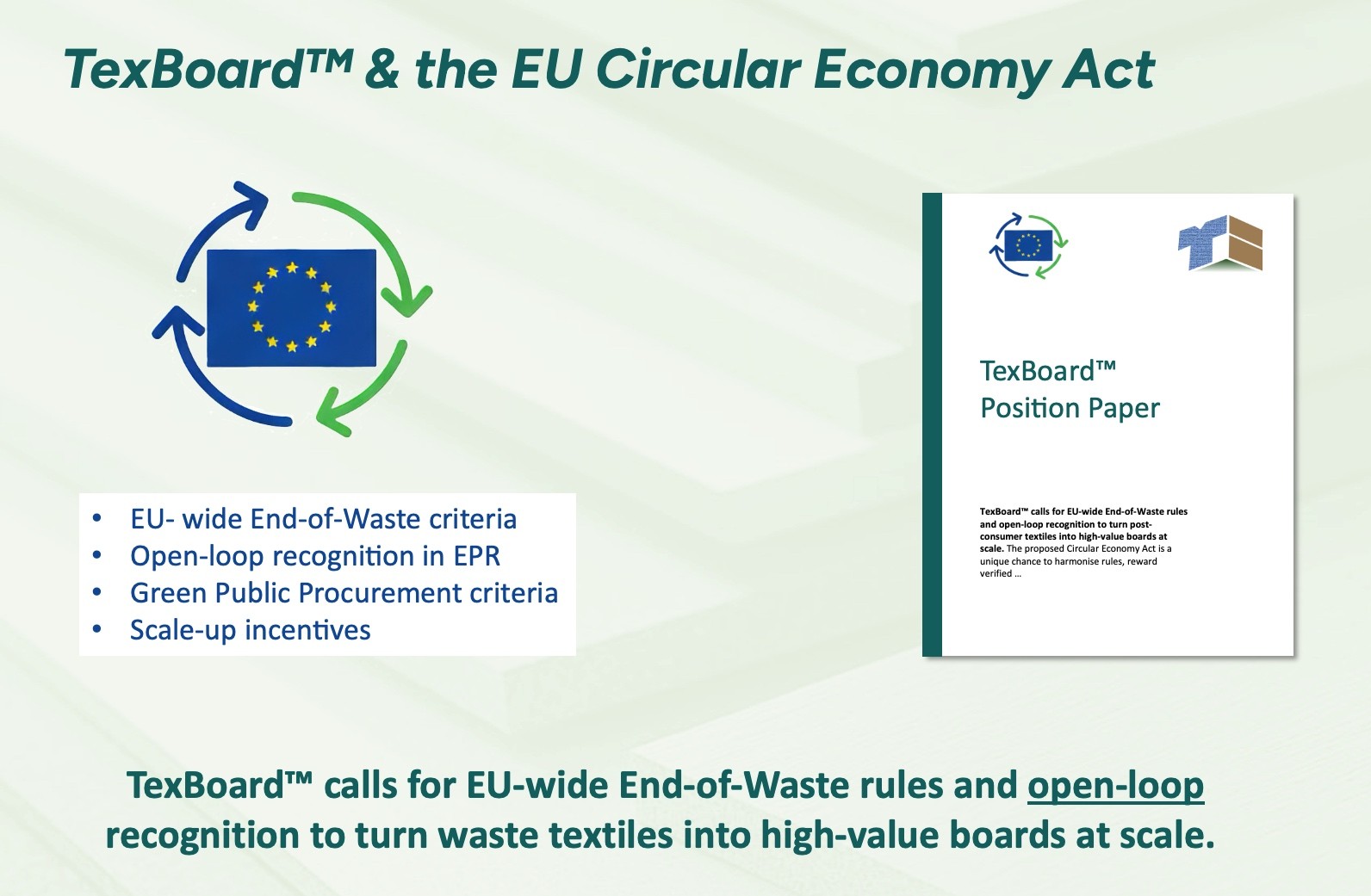
EU-wide End-of-Waste criteria
Recognition of open-loop recycling in EPR
Green Public Procurement criteria
Scale-up incentives for SMEs
Our Four Policy Recommendations
1. EU-wide End-of-Waste Criteria
Establish harmonised EU rules for textile-based composites (boards, panels) so they are treated as materials, not waste.
2. Recognition of Open-Loop Recycling in EPR
Credit pathways like textiles → boards in Extended Producer Responsibility schemes. This allows brands, PROs, and SMEs to cooperate on innovative solutions .
3. Embed Innovation in Green Public Procurement (GPP)
Require public projects (schools, libraries, housing) to use verified secondary-textile materials. Municipal pilots can normalize adoption and reduce risk perception.
4. Scale-Up Incentives
Provide CAPEX/OPEX support for plants using >50% secondary textile feedstock. Create regional hubs to accelerate adoption .
Sustainability & Business Impact
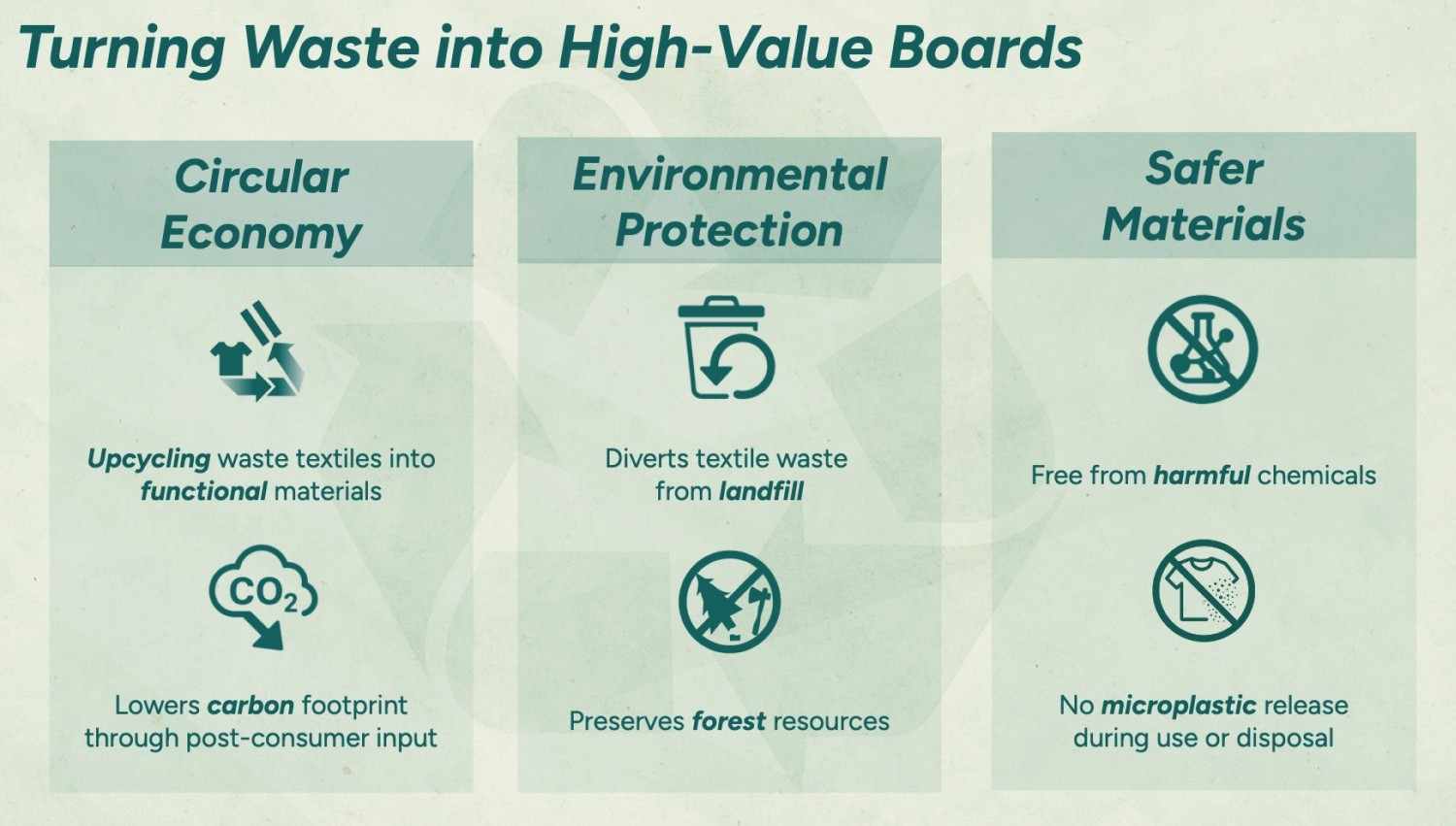
CO₂ Reduction: replacing virgin particleboard reduces embodied emissions.
Resource Efficiency: maximises yield from mixed textiles, reduces water & land use.
Deforestation Impact: reduces dependency on virgin timber.
Market Potential: scalable, cost-competitive, SME-friendly .
TexBoard™ Use Case
TexBoard™ is one SME innovator already turning post-consumer textiles into engineered panels.
Our case illustrates how EU-level policy can unlock new industrial pathways from currently non-recyclable fractions .
Download the Full Position Paper
📄 [Download the Position Paper on the EU Circular Economy Act (PDF)]
Closing Statement
Europe’s textile waste challenge can be turned into a strategic opportunity. By aligning innovation with policy, we can make hard-to-recycle textiles part of the EU’s deforestation-free, circular economy future.