Fibre Alchemy by Chance
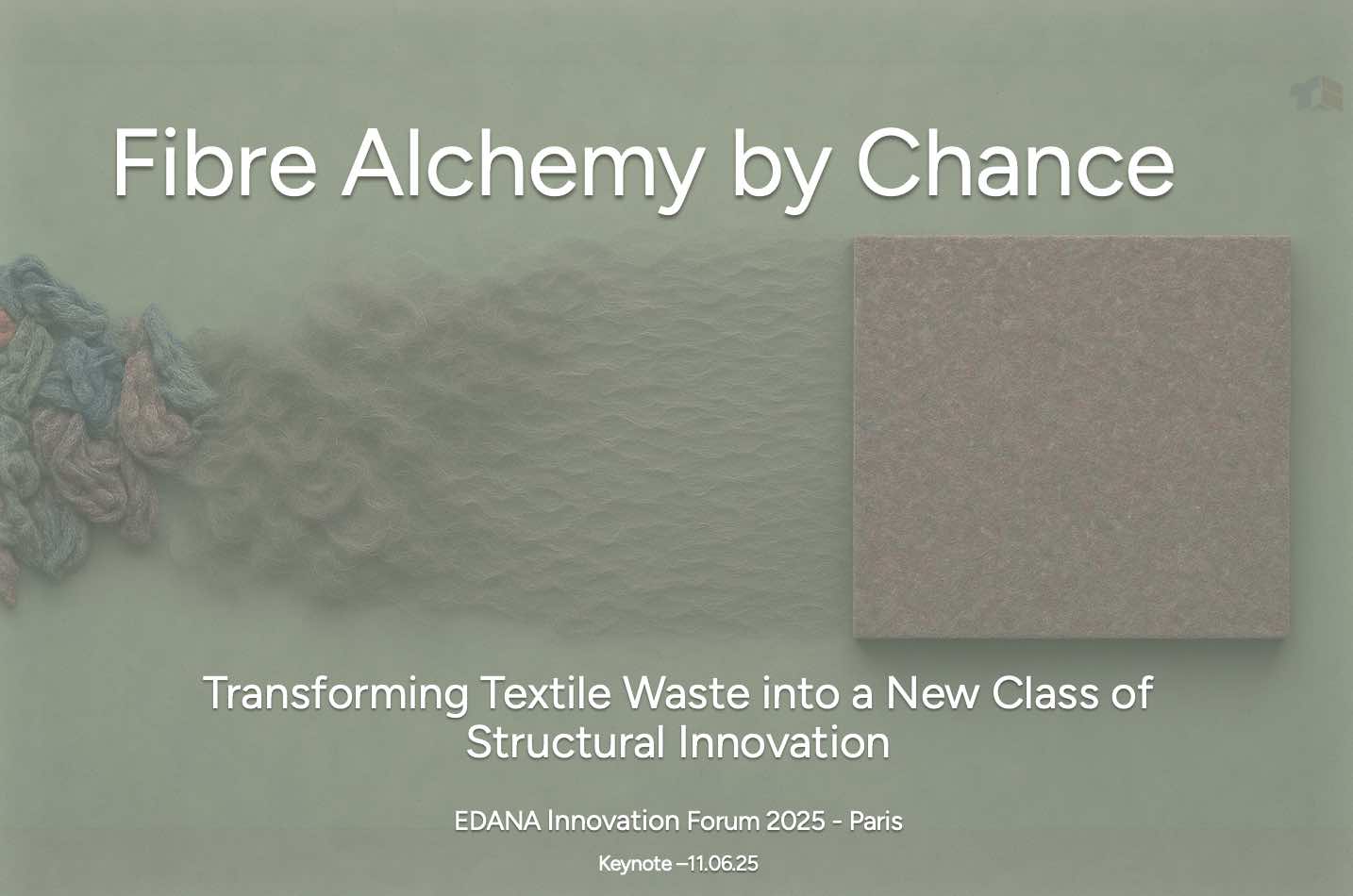
At the EDANA Innovation Forum 2025 in Paris, the keynote “Fibre Alchemy by Chance” explored how unexpected observations, material expertise and serendipity led to the transformation of textile waste into a new class of structural materials.
11 Jun 2025
Intro
Innovation rarely starts with a perfect plan.
It often begins with an unexpected result — noticed by people who are prepared to see it.
At the EDANA Innovation Forum 2025 in Paris, I was invited to share this perspective in a keynote titled
“Fibre Alchemy by Chance – Transforming Textile Waste into a New Class of Structural Materials.”
Setting the Scene: EDANA Innovation Forum
The EDANA Innovation Forum 2025 brought together leaders from research, industry and regulation to explore sustainable fibers, circular systems and emerging technologies.
My keynote took place within the workshop “Capturing Serendipity – Harnessing the Unexpected in Research and Innovation” — a fitting context for a story about how innovation often emerges where plans end and observation begins.
From Serendipity to Structure
The story behind TexBoard™ began with a familiar challenge:
textile recycling was reaching its limits.
Then, during an experiment, something unexpected happened.
A fleece of mixed textile waste entered a heated press — and came out rigid instead of soft.
A carpenter in the team turned it in his hands and said:
“This feels like the beginning of a board.”
That moment — an anomaly rather than a breakthrough — shifted everything.
What Makes TexBoard™ Different
TexBoard™ is not a derivative of existing board technologies.
It represents a new class of structural material — engineered through fibre entanglement, thermal bonding and controlled randomness, rather than resin-heavy systems or wood-derived feedstocks.
No resin-heavy systems
No wood-based raw material
Mechanical performance driven by fibre behaviour
Early testing already indicates strength-to-weight ratios beyond plywood and promising performance at lower density. Validation continues, but the direction is clear.
From Accident to Algorithm
Over time, the discovery evolved into a repeatable and scalable process.
Textile recovery, controlled blending, web formation, heat and pressure became a structured pathway — transforming an unexpected result into an engineered material system.
This is more than recycling.
It is engineering structure from softness.
The Role of Serendipity in Circular Innovation
The keynote deliberately reframed innovation as a cultural capability, not just a technical one.
Breakthroughs tend to occur where interdisciplinary teams:
observe anomalies,
question assumptions,
and allow experiments to evolve beyond initial plans.
In circular systems — where complexity and uncertainty are the norm — serendipity is not luck.
It is a capability that can be cultivated.
Why This Matters to the Industry
Circularity requires more than better recycling.
It demands:
new categories of materials,
new design principles,
and new ways of organising research.
TexBoard™ demonstrates how innovation can emerge at intersections — between chemistry, textile engineering, craftsmanship and curiosity — and how constraints can become drivers rather than barriers.
Conclusion
The EDANA keynote offered a stage to share not only the technical pathway of TexBoard™, but the mindset that made it possible.
The response in Paris highlighted a growing need for innovation cultures that embrace uncertainty — and create space for the unexpected.
“Not every machine is an alchemist’s tool — but sometimes curiosity turns it into one.”