TexBoard™ at TU Wien: Material Innovation Driven by Lean Startup Thinking
TexBoard™ at TU Wien: a deep-tech case study on how material innovation is guided by Lean Startup principles, with MVPs as core learning and decision-making instruments.
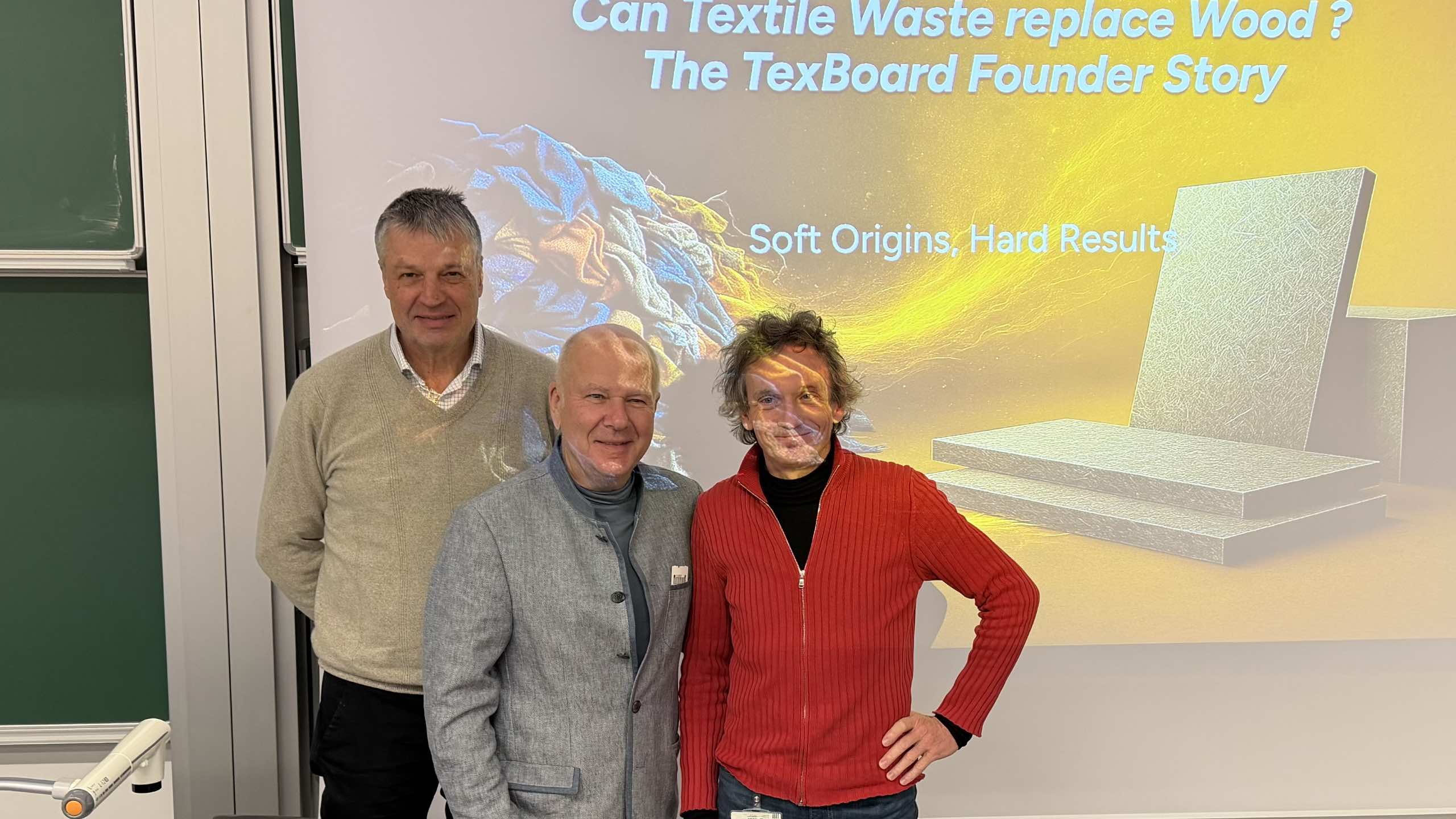
7 Jan 2026
TexBoard™ recently had the opportunity to present its founder story at the Vienna University of Technology (TU Wien) as part of the Industry Seminar series at the Institute of Chemical, Environmental and Bioscience Engineering.
At one of Europe’s most renowned technical universities, the session combined material innovation with Lean Startup methodology, addressing not only what TexBoard™ is, but how such a technology-driven venture can be developed under high uncertainty.
Starting from the question “Can textile waste replace wood?”, the presentation introduced TexBoard™ as a new class of textile-based panel materials by the technology based on DELL'ORCO & VILLANI SRL as well as TECHNOplants s.r.l.. However, the core message went beyond the product itself:
innovation does not start with a finished solution, but with structured learning.
A central element of the talk was the role of the Minimum Viable Product (MVP)—not as an early product, but as a decision-making and learning instrument. Using a Lean Startup “compass,” the MVP was positioned at the intersection of four validation dimensions: Technology, Market, Performance, and Environment.
This approach illustrated how TexBoard™ moved from a wide field of ideas to three clearly defined MVP pathways:
Ultra-thin structural layers as a technology-driven MVP
Circular business models with furniture and bedding manufacturers as a market-driven MVP
High-performance applications in wet and humid environments as a performance-driven MVP
The discussion with the students was highly engaged and constructive, reinforcing the relevance of both the material innovation and the methodological framework. In particular, questions around durability, moisture behavior, emissions, and application potential confirmed that TexBoard™ addresses real technical and market challenges, not theoretical ones.
The session concluded with five key learnings, highlighting that:
MVPs are learning instruments, not products
focus matters more than vision
markets shape products, not the other way around
sustainability does not replace a viable business model
and scaling comes last
TexBoard™ would like to sincerely thank TU Wien and Andreas Bartl, Head of the Industry Seminar, for the invitation and for fostering an environment where engineering excellence, sustainability, and entrepreneurial thinking intersect.